
Top 7 Places Businesses Are Using LED Displays Across India in 2025
From the gleaming malls of Mumbai to the glass corporate towers of Bangalore — LED displays have quietly become the most powerful visual communication tool in Indian business. Here are the 7 locations where smart businesses are installing them, and what they’re achieving.
India added over 4.2 million square feet of new Grade A commercial real estate in 2024 alone. Every square foot of that space is a potential brand touchpoint — and businesses that have deployed LED displays in the right locations are seeing measurable lifts in dwell time, recall, and conversions. What follows are seven of those locations, grounded in real deployment patterns Rokon Solutions observes serving clients pan-India.
Retail Malls & Shopping Centres
Walk into Phoenix Palladium in Lower Parel or Seawoods Grand Central in Navi Mumbai today and LED displays are impossible to miss — atrium video walls that span three floors, dynamic digital directories that replace static signboards, and brand activation zones anchored by curved pixel LED installations. Retail malls were among the earliest and most aggressive adopters of LED display technology in India, and for good reason.
For mall operators, outdoor LED facades on the building exterior serve a dual commercial function: attracting footfall from arterial roads and generating premium advertising revenue from anchor brands. A well-positioned outdoor LED display on a Mumbai high-street mall facade — running at 6,000–8,000 nits to cut through afternoon sunlight — can recover its installation cost through advertising slots alone within 18–24 months.
Inside, indoor fine-pitch LED video walls (P2–P3) in food courts, brand zones, and main atriums create immersive environments that extend shopper dwell time. Research across Asia-Pacific retail formats consistently shows that dynamic digital displays increase time-on-floor by 15–30% compared to static signage — a figure mall operators in Pune’s Amanora and Pheonix Marketcity Bangalore are actively leveraging.
Corporate Offices & IT Parks
Bangalore’s tech corridors — Whitefield, Electronic City, Manyata Tech Park — are where India’s indoor LED video wall market truly comes into its own. Global technology companies and Indian IT majors have set a new benchmark: the reception lobby is no longer a waiting room. It is the first and most powerful brand statement a client, investor, or new hire encounters.
The standard installation in a premium Bangalore or Gurugram corporate lobby today is a P2 or P2.5 fine-pitch LED wall spanning 8–16 feet wide, running brand films, real-time data dashboards, or architectural visualisations 24/7. The pixel density at these specifications delivers near-broadcast quality imagery at close quarters — something LCD video walls, despite their lower price, genuinely cannot match in seamless, bezel-free presentation.
Beyond the lobby, corporate boardrooms in Delhi NCR’s Aerocity and Cyber City complexes increasingly use modular LED panels as primary presentation surfaces, replacing the last generation of large-format LCD displays. The key advantage: a 4×2 metre LED wall has zero bezels, accepts any aspect ratio, and remains perfectly legible whether displaying a slide deck or a live video call wall — making hybrid meeting rooms dramatically more professional for international audiences.
Hotels, Resorts & Convention Centres
Hyderabad’s hospitality sector is on a remarkable growth curve, fueled by its position as India’s MICE (Meetings, Incentives, Conferences, Exhibitions) capital. The Hyderabad International Convention Centre (HICC) and the constellation of five-star properties in the Financial District and Banjara Hills have driven some of the most sophisticated LED display installations in the country.
In a luxury hotel context, the LED display brief is fundamentally different from retail or corporate. Colour accuracy, smooth gradient rendering, and seamless panel-to-panel uniformity are non-negotiable — a slight colour temperature mismatch visible across a ballroom-scale video wall during a high-profile wedding or product launch will reflect poorly on the venue. Premium P2 panels with factory-calibrated colour uniformity are the specification of choice for this segment.
Beyond ballrooms, hotels are deploying LED displays in three other high-impact zones:
Lobby Statement Walls
A floor-to-ceiling LED installation in a hotel lobby — displaying slow-motion landscape films or brand content — creates an “Instagram moment” that guests photograph within minutes of arrival. Several Mumbai five-star properties near BKC and Nariman Point report that their lobby LED walls are among the most tagged locations on social media, generating earned media reach they did not budget for.
Outdoor Entrance & Porte-Cochère Displays
For hotels on Hyderabad’s main arterials or Mumbai’s busy hotel strips, outdoor LED panels above the main entrance serve as a live marquee — announcing events, conferences, and seasonal promotions to passing traffic. These installations require IP65 ratings and high brightness (5,000+ nits) to remain readable during daylight hours.
Restaurant & Rooftop Ambience Screens
Specialty restaurants in premium hotels are using narrow-bezel LED panels to create immersive backdrop environments — a digital seascape in a seafood restaurant, a live cityscape for a rooftop bar. This application has a very high visual impact relative to its installation cost.
Outdoor Billboards & Transit Advertising
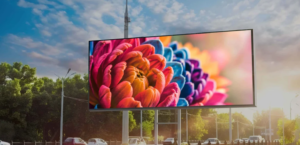
Outdoor LED billboards represent the most visible and commercially understood application of LED technology in India. Delhi NCR’s highway corridors — NH-48 towards Gurugram, the Noida Expressway, and the Dwarka Expressway — are lined with large-format outdoor LED displays that deliver something the traditional hoarding industry never could: dynamic, remotely updatable content that can change multiple times a day to suit different advertisers or time-of-day contexts.
For a media owner or large business with a prominent outdoor site, the economics are compelling. A traditional vinyl hoarding requires printing and installation costs every time a campaign changes — typically ₹15,000–₹50,000 per change cycle, plus turnaround time. An outdoor LED display at the same location changes content instantaneously via cloud software, allows multiple advertisers to share the slot on a rotating basis (multiplying revenue per hoarding), and does so 24 hours a day with no recurring printing cost.
Along Mumbai’s Western Express Highway and Eastern Freeway, outdoor LED displays face the additional challenge of India’s most aggressive monsoon season. Installations here demand IP66-rated cabinets with pressure-sealed edges and robust drainage channels — not the bare-minimum IP65 that suffices for drier climates. Rokon Solutions has installed and maintained outdoor displays along Mumbai’s coastal corridors and understands this requirement at an engineering level, not just a specification checkbox.
Stadiums & Sports Arenas
India’s sports infrastructure is undergoing its most significant upgrade cycle since the 2010 Commonwealth Games. IPL cricket, Pro Kabaddi League, ISL football, and the country’s growing appetite for international sporting events have created strong demand for professional-grade LED display systems in stadiums — a segment that has very specific and uncompromising technical requirements.
Stadium LED displays must perform flawlessly at two functions simultaneously: scoreboard and replay screens visible to every seat in the venue, and perimeter advertising boards that are broadcast-camera facing. The latter is particularly demanding — these panels are captured in slow-motion replays by broadcast cameras at 120fps or higher, which means a low-refresh-rate LED panel will show visible flicker on national television, embarrassing both the venue and the advertisers on the boards.
The minimum refresh rate specification for any broadcast-facing perimeter board is 3,840 Hz, with premium installations running at 7,680 Hz. Pixel pitch for perimeter boards is typically P6–P8 (visible from close range by camera) while main scoreboard screens at the ends of a cricket stadium use P10–P16 (for long-distance crowd viewing). These are not interchangeable — getting the specification wrong for each zone is a costly mistake.
Airports & Metro Stations
India’s airports handled over 370 million passenger trips in FY2024 — a captive, high-dwell-time audience that is the envy of every advertiser in the country. Mumbai’s Chhatrapati Shivaji Maharaj International Airport, Delhi’s IGI, and Hyderabad’s Rajiv Gandhi International Airport have transformed their terminal interiors into premium LED display environments that serve two masters simultaneously: passenger information and commercial advertising.
The technical demands here are among the most rigorous in the industry. Airport LED displays must operate continuously for 16–20 hours per day, maintain colour consistency across hundreds of panels installed months apart, and meet strict civil aviation authority guidelines on brightness levels in specific terminal zones. The content management system must integrate with FIDS (Flight Information Display Systems) for departure/arrival boards while simultaneously scheduling advertising slots with commercial precision.
For businesses not operating airports directly, the airport LED ecosystem represents an advertising placement opportunity: airport media concessionaires offer brands high-visibility LED placements in arrival halls, immigration queues, and departure lounges at premium CPMs — justified by the high-income, decision-making demographic that airports deliver. Several of Rokon Solutions’ clients have inquired about content and system integration for exactly this type of deployment.
Metro station LED deployments across the Delhi Metro, Bangalore Metro (Namma Metro), and Hyderabad Metro follow a similar dual-purpose model — passenger information interspersed with advertising — and are accelerating as metro networks expand into new corridors across Pune, Chennai, and Ahmedabad.
Educational Institutions & Auditoriums
India’s top universities, engineering colleges, and business schools — concentrated in Pune, Hyderabad, and Bangalore — are the most recent major adopters of LED display technology, and they represent one of the fastest-growing institutional segments in the market. The driver is straightforward: as these institutions compete for students, faculty, and research partnerships on a global stage, their infrastructure must communicate that ambition visually.
Pune alone — home to Symbiosis, COEP, and dozens of engineering institutions across the city and PCMC corridor — has seen a significant uptick in enquiries for large-format indoor LED walls for main auditoriums and seminar halls. A P3 or P4 LED wall spanning 12–20 feet in an auditorium delivers presentation clarity that a traditional projector-screen setup simply cannot match: no ambient light washout, no lamp replacement costs, no alignment issues, and a dramatically more professional visual impression during convocations, industry lectures, and student events.
Hyderabad’s booming private university sector — clustered around Shamshabad, Gachibowli, and Medchal — is similarly investing in institutional LED infrastructure. The brief typically includes the main auditorium screen, an outdoor entrance display for the campus gate, and increasingly, indoor wayfinding displays in large multi-building campuses that replace printed directory boards with dynamic, updateable screens managed centrally.
Quick-Reference: LED Display by Location
Use this table to quickly match your business type to the right LED display configuration:
| Location Type | Recommended Type | Pixel Pitch | Key Cities | Primary Goal |
|---|---|---|---|---|
| Retail Mall | Outdoor + Indoor | P3–P4 (in) · P8–P10 (out) | Mumbai, Pune, Bangalore | Footfall & dwell time |
| Corporate Office | Indoor | P1.5 – P2.5 | Bangalore, Delhi NCR, Hyderabad | Brand perception, productivity |
| Hotel / Convention | Outdoor + Indoor | P2–P3 (in) · P8 (out) | Hyderabad, Mumbai, Goa | Ambience & event revenue |
| Outdoor Billboard | Outdoor | P8 – P16 | Delhi NCR, Mumbai, Ahmedabad | Advertising revenue |
| Stadium / Arena | Outdoor | P6–P10 (score) · P6–P8 (perim) | All metros | Fan experience & broadcast |
| Airport / Metro | Semi-outdoor + Indoor | P2–P3 (in) · P4–P5 (semi) | Mumbai, Delhi, Hyderabad | Info display + advertising |
| Education / Auditorium | Indoor | P3 – P4 | Pune, Hyderabad, Bangalore | Presentation clarity |
The Common Thread Across Every Location
Whether it’s a luxury hotel lobby in Hyderabad, an IT park boardroom in Bangalore, or a highway billboard in Delhi NCR — the businesses getting the most from their LED displays share three things: they chose the right specification for their environment, they worked with a supplier who understood after-sales service, and they treated the display as a long-term infrastructure investment rather than a one-time purchase. The wrong LED display for a location doesn’t just underperform — it fails, often expensively. The right one pays for itself and then keeps earning.
Rokon Solutions has executed LED installations across all seven of these location types, for clients ranging from single-site SMEs to multi-location corporates across Maharashtra, Karnataka, Telangana, and NCR. If your business fits one of these profiles — or you’re planning a location type not covered here — reach out for a site-specific consultation.
Pan-India LED Display Specialist
Ready to Transform Your Location with LED?
Rokon Solutions provides complete end-to-end LED display solutions — from site survey and specification to supply, installation, and annual maintenance contracts — across Mumbai, Delhi, Bangalore, Hyderabad, Pune, and all major Indian cities.